
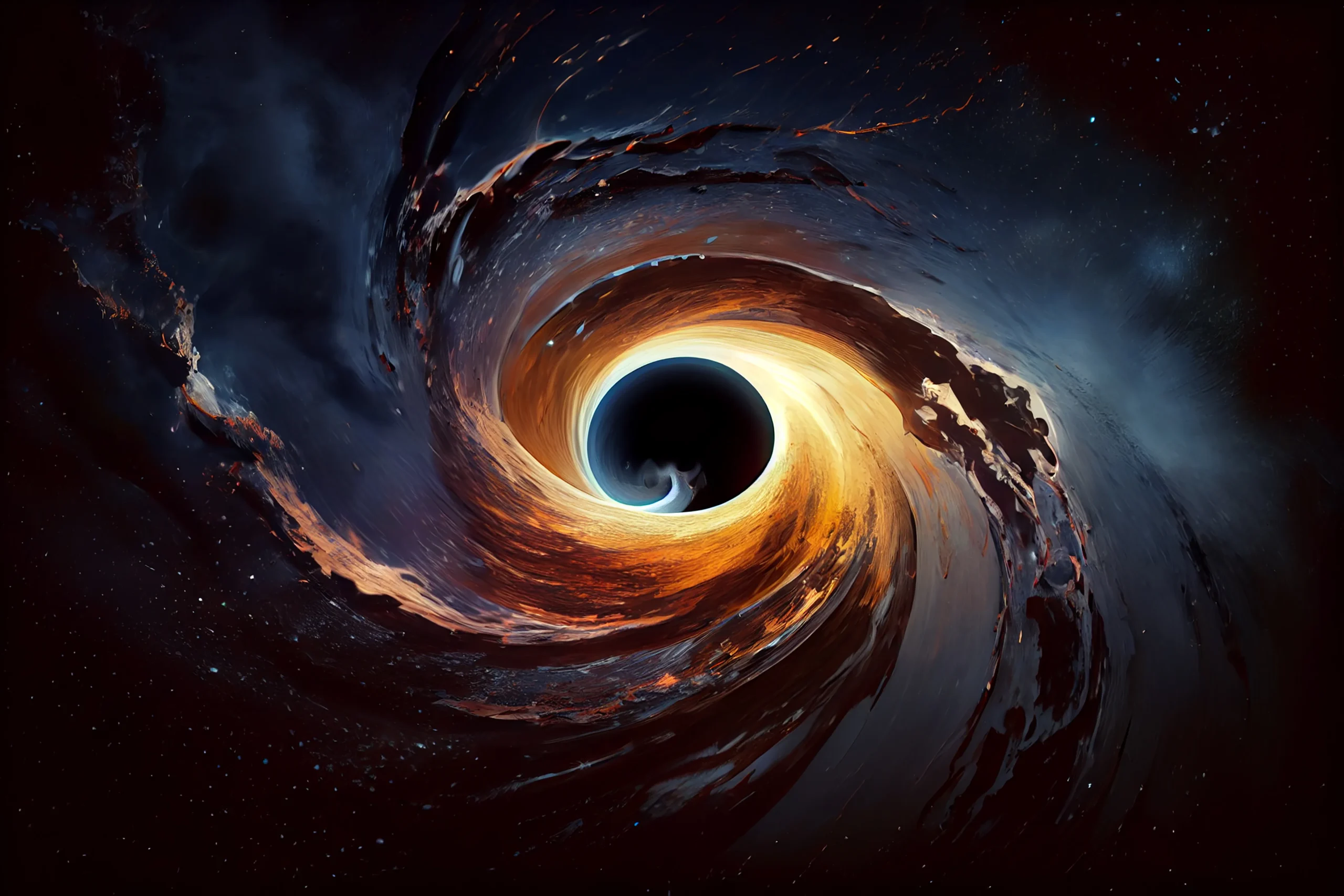
One of the extreme and most interesting phenomena in the contemporary astrophysics is black holes. These objects are created when the massive stars collapse under their own weight resulting in gravitational forces that are so strong that not even light can escape after reaching a limit called the event horizon. The existence of them was initially predicted by general relativity equations created by Albert Einstein, but observational evidence was later discovered much later.
Black holes are categorized and classified. Stellar-mass black holes are typically the result of the explosion of a supernova whereas supermassive black holes are in the centre of a galaxy. The Sagittarius A+ is the supermassive black hole found in the middle of the galaxy of the Milky Way. It has very strong gravitational pull that controls the orbiting movement of the nearby stars.
The matter that is attracted to a black hole forms an accretion disk that becomes hot to very high temperatures and releases a lot of radiation before passing through the event horizon. Quite on the contrary, because the assumption was made early on, black holes do not actively consume everything around them; their gravitational effect is not governed by other laws of physics, only in the sense that they are large.
In 2019, scientists were able to take the first direct image of a black hole thanks to recent discoveries of the Event Horizon Telescope, a discoverive breakthrough in the history of observational astronomy. These results proved generations of theoretical speculations.
The study of black holes keeps capturing additional knowledge on gravity, curvature of space-time and high-energy physics. Other phenomena that scientists are studying include gravitational waves, that are emitted during the merging of black holes.
CHUMASHCASINOSANTAYNEZ.NET investigates black holes as the important part of the evolution of the cosmos as the extreme environments promote the larger organization and processes of the universe.